PS Sandwich Panel: XPS VS PU Sandwich Panel Comparison
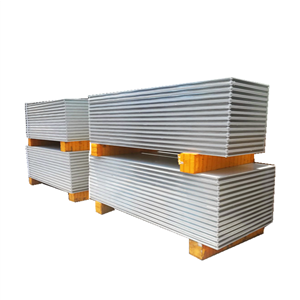
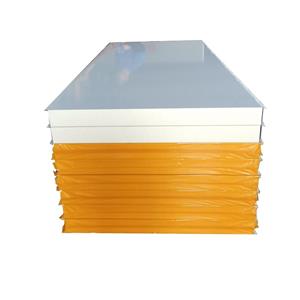
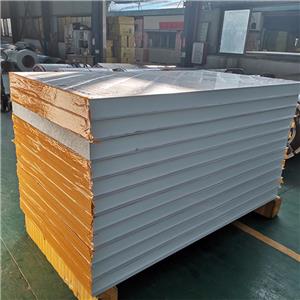
⚖️ XPS sandwich panel and PU sandwich panel are two widely‑used foam‑core thermal‑insulation wall materials for industrial buildings, logistics warehouses and partial clean‑room auxiliary areas. XPS sandwich panel and PU sandwich panel both adopt closed‑cell foam structure, delivering good thermal insulation and low water‑absorption performance. However, obvious differences exist in compression resistance, temperature adaptability, fire performance and long‑term stability. Many procurement engineers cannot distinguish applicable scenarios between XPS sandwich panel and PU sandwich panel. Wrong selection may bring thermal shrinkage, brittleness or higher long‑term operating‑energy‑consumption risks. Based on numerous South‑China project cases, SAMZOON carries out multi‑dimensional comparison and scenario‑based suggestions for XPS sandwich panel and PU sandwich panel.
?️Compressive Strength PerformanceXPS sandwich panel shows outstanding compressive strength. Extruded closed‑cell structure enables XPS sandwich panel to bear higher static pressure load. XPS sandwich panel is suitable for floor‑related insulation and load‑bearing partition conditions. PU sandwich panel’s compression performance depends on foam density. Ordinary‑density PU sandwich panel has lower compression resistance than high‑quality XPS sandwich panel. High‑density customized PU can reach comparable compression level, but material cost will rise sharply.
?Water Absorption & Moisture StabilityBoth XPS sandwich panel and PU sandwich panel own low water‑absorption rate thanks to closed‑cell structure. XPS sandwich panel has extremely low water‑absorption index. But cutting cross‑sections break closed‑cell protection for XPS sandwich panel, sealing treatment is still mandatory. Qualified PU sandwich panel also keeps stable performance in humid environment. For coastal high‑humidity projects, both XPS sandwich panel and PU sandwich panel require strict edge‑sealing for all cutting and drilling positions.
?️Thermal‑Insulation & Temperature AdaptabilityPU sandwich panel has lower thermal‑conductivity coefficient. Under same‑thickness condition, PU sandwich panel achieves better thermal‑insulation effect and reduces long‑term refrigeration energy consumption, which is the core advantage for formal cold‑storage projects. XPS sandwich panel has poorer high‑temperature resistance; XPS sandwich panel is prone to thermal shrinkage when facing continuous heat radiation. Meanwhile, ordinary XPS sandwich panel will turn brittle under long‑term ultra‑low‑temperature operation. Modified formula is required for low‑temperature scenarios. PU sandwich panel has wider stable working‑temperature range, more suitable for standard cold‑storage facilities.
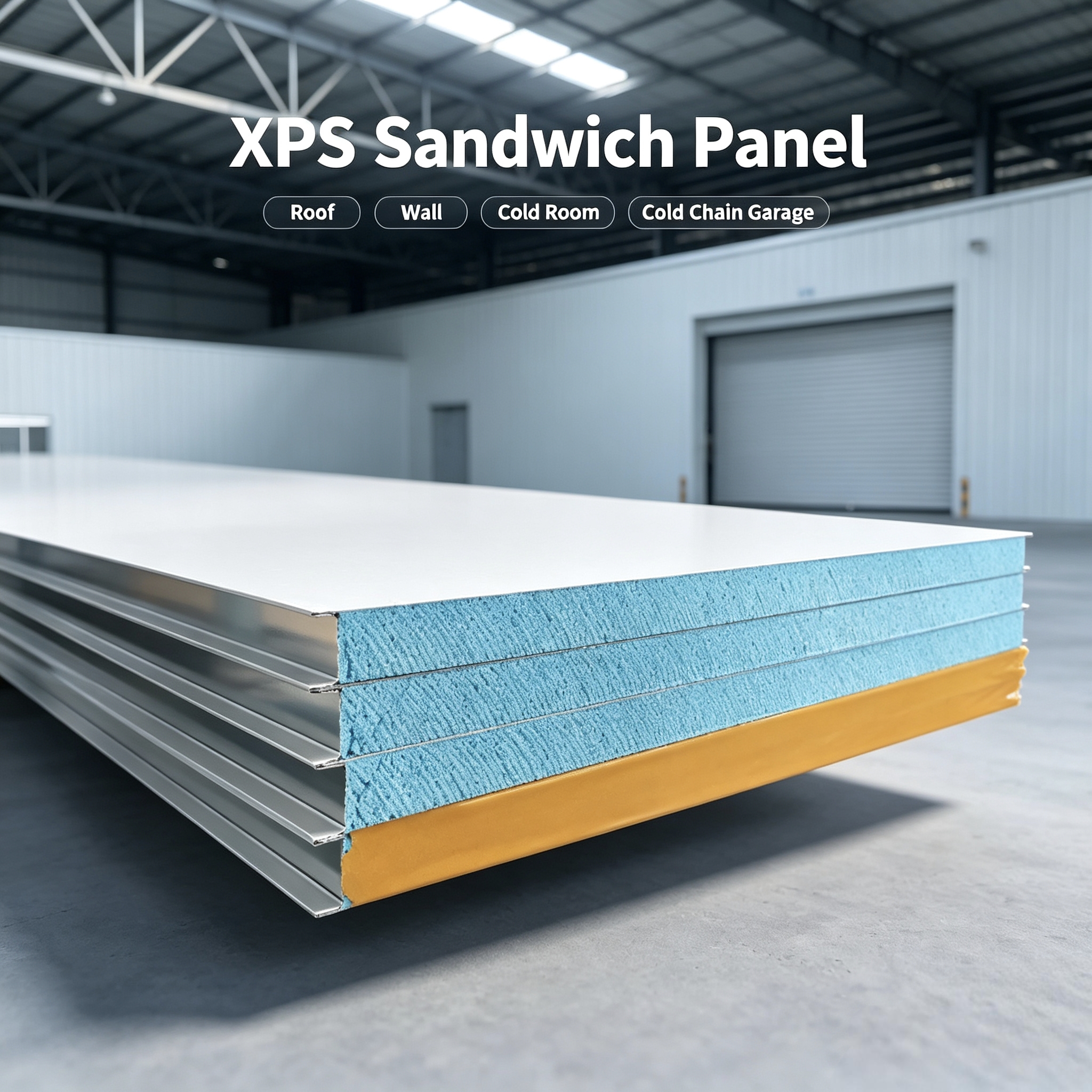
?Fire‑Reaction PerformanceXPS sandwich panel and PU sandwich panel are combustible base materials. Both can reach limited‑combustible grade after adding qualified flame‑retardant additives. XPS will melt and drip when burning. Fire‑retardant efficiency of XPS tends to degrade more obviously after long‑term aging. Fire‑retardant modified PU sandwich panel also produces molten drop under flame. Neither XPS sandwich panel nor PU sandwich panel can be regarded as non‑combustible material. Finished‑product third‑party test reports shall be required for project bidding and acceptance.
?Material Cost & Construction EfficiencyUnder conventional specification, XPS sandwich panel usually has cost advantage compared with equal‑thickness PU sandwich panel. XPS sandwich panel is lightweight and convenient for transportation and handling. PU sandwich panel has heavier weight in high‑density version. Installation speed for both panels is similar. Custom low‑temperature‑resistant formula will push up material cost for both XPS sandwich panel and PU sandwich panel.
?Scenario‑Oriented Selection Suggestions‑ XPS sandwich panel: priority for constant‑temperature workshops, logistics auxiliary rooms, high‑humidity industrial insulation, load‑bearing insulation positions. Avoid direct application for deep‑freeze cold‑storage and areas close to continuous high‑temperature heat sources unless using modified XPS sandwich panel. ‑ PU sandwich panel: preferred choice for standard cold‑storage warehouse, refrigeration area, projects pursuing high‑efficiency thermal insulation.
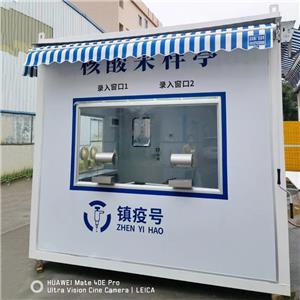
? As a Foshan local source manufacturer, SAMZOON produces XPS sandwich panel and PU sandwich panel. We support customized formula adjustment, urgent production scheduling and free sample testing. Our technical team provides professional material‑selection suggestions according to project temperature, load condition, fire‑protection requirement and budget, helping customers avoid wrong‑selection risks. A large number of South‑China industrial and logistics project cases are available for your reference.
When choosing XPS sandwich panel versus PU sandwich panel, do not only compare unit price. Balance compression requirement, operating‑temperature range, long‑term energy‑saving demand and fire‑protection regulations. Rational material matching is the key to guarantee stable project operation.