Magnesium Oxysulfate Cleanroom Panels vs Rock Wool Cleanroom Panels: Definition & Selection Boundary
? Core Definition
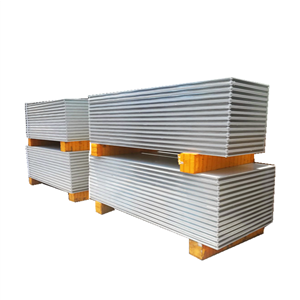
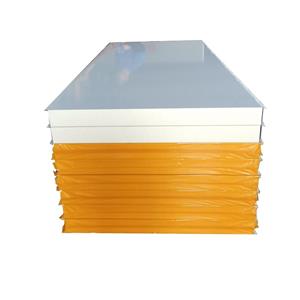
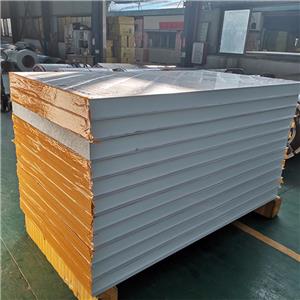
Magnesium oxysulfate cleanroom panel — a sandwich composite whose core is a monolithic inorganic board formed by reacting active magnesium oxide (MgO) with magnesium sulfate (MgSO₄) solution, modified with fillers and reinforced with alkali-resistant glass-fiber mesh. The cured core is rigid, dimensionally stable, low-halogen and A1 non-combustible. Face skins are typically PVDF-coated galvalume steel, pre-painted steel or 304/316L stainless. There is no fibrous layer inside. The panel is cut, routed and sealed like a solid board .
Rock wool cleanroom panel — a sandwich composite whose core is manufactured by melting basalt and diabase at ~1,500 °C, then high-speed spinning into intertwined mineral fibers bound with thermosetting resin. The resulting mat is flexible, open-pore and hygroscopic. Face skins are normally color steel or stainless. The core is a fibrous blanket, not a rigid board .
⚠️ Industry misconception: "Both carry A1 fire rating, so they perform the same in a cleanroom." Wrong. Fire classification measures reaction to fire under test conditions. It does not measure moisture uptake, core sag, particle shedding from cut edges, or long-term dimensional stability under GMP operating cycles. Same A1 label, completely different service envelope.
? Where the Two Materials Actually Diverge
Parameter | Rock Wool Cleanroom Panels (Fibrous Core) | Magnesium Oxysulfate Cleanroom Panels (Rigid Board) |
|---|---|---|
Core nature | Basalt fiber mat, resin-bound, open pore | MgO-MgSO₄ inorganic cement, glass-fiber mesh, closed pore |
Fire performance | A1, melt point ~1,000 °C, excellent high-heat partition | A1, inorganic, no melt drip, stable to 800 °C |
Moisture behavior | Hygroscopic; absorbs ambient humidity, core sags in 12–36 months if edge-seal fails | Low water absorption (≤8% low-halogen grade); no sag; dimensionally stable |
Core stability | Fibers settle, slump, leave voids in tall runs; screw-hold degrades | Rigid monolithic board; screw-hold ≥15 MPa; no slump |
Cleanability | Cut edges shed micro-fibers; open pore traps dust if unsealed | Non-shedding solid core; cut edge sealed with inert compound |
Surface hardness | Soft core; fastener over-torque crushes local zone | Hard rigid core; torque-limited fastener seats flush |
Weight (50 mm) | ~12–16 kg/m² (depends on density 100–120 kg/m³) | ~18–24 kg/m² (density 950–1,200 kg/m³) |
Relative cost | Baseline (≈1×) | ≈+15–30% on core spec |
Best-fit zones | High-temp fire compartment, external firewall, non-humid corridor | GMP walls, OR, food dry/wet line, lab, pharma Grade C/D, humidity-controlled cleanroom |
? Selection Boundary (No Overlap Confusion)
? Specify rock wool cleanroom panels only when:
The project is a high-temperature fire partition or external firewall where melt-point matters more than moisture stability
Ambient RH is controlled below 45% year-round and edge sealing is certified four-side
Budget governs and the wall is a non-humid buffer, stairwell or mechanical-room enclosure
No washdown, no VHP, no chlorine fog touches the wall surface
Ceiling load is not critical (rock wool is lighter, easier for suspended non-load ceilings)
? Specify magnesium oxysulfate cleanroom panels when any one of these is true:
Humidity-controlled cleanroom (RH 50–70%), tropical or coastal site where rock wool would wick moisture
Food processing, pharmaceutical Grade C/D, hospital corridor, lab where A1 non-combustible core must not sag or shed
Wall face requires screw-fixed equipment, handrails or brackets needing high screw-hold strength
Client audit references GB 8624 A1, EN 13501 A1, and surface integrity must hold 10+ years without core settlement
Chloride efflorescence risk is managed by specifying low-halogen formulation with chloride ≤0.03% — the SAMZOON magnesium oxysulfate cleanroom panels specification default
⚠️ Risk Flags on Magnesium Oxysulfate (Must Be Disclosed)
❌ Magnesium oxysulfate cleanroom panels chloride efflorescence risk — if formulated with excess MgCl₂ and no modifier, white alkali crystals appear at seams in humid conditions. Mitigation: demand chloride lab slip ≤0.05%, phosphate/silicate modification, sealed-edge profile.
❌ Magnesium oxysulfate cleanroom panels vs rock wool cleanroom panels weight gap — MgO panel is ~30–50% heavier. Verify structural frame and ceiling hanger rating before specifying.
❌ Brittle edge — magnesium oxysulfate cleanroom panels screw-hold strength is high but impact resistance at corners is low. Require corner guards and suction-lift handling.
? SAMZOON Specification Note
SAMZOON supplies both systems from the Foshan source line, but positions magnesium oxysulfate cleanroom panels strictly for humidity-stable, A1-required enclosures: low-halogen MgO-MgSO₄ core, double alkali-resistant glass-fiber mesh, density 950–1,200 kg/m³, four-side sealed profiles, PVDF/304/316L face options, free pre-bid samples, and on-site node review for hospital OR, pharma GMP and South China food-washdown projects. For high-temp fire partitions where extreme melt-point is the priority, the same factory issues certified rock wool cleanroom panels with verified density and edge-seal so the specifier keeps compliance without substituting undocumented core grades.